8 Rules For Making a Perfect Harem Anime

So, you’re an average Joe or Jane living an average life, when suddenly a mob of breathtakingly-attractive members of the opposite sex (or the same sex; I ain’t judgin’) appear out of nowhere and start fighting over you. It sounds like a dream, but since they’re all a bit unhinged, violent toward one another, and don’t give a damn about property damage, your potential orgy becomes a crazy romantic comedy instead. If this has ever happened to you, you should visit an insurance agent forthwith, but you are probably also the protagonist of an anime harem romantic comedy. (How are you reading my blog?!)

The harem romantic comedy subgenre (“harem” for short) has ebbed and flowed in popularity over the years, and I would say it hit its high water mark in both volume and quality in the 1990s through very early 2000s. It has never completely gone away, though, and probably never will, because the general setup has proven time and again to be such a rich vein for sweet, sexy, and hilarious moments. With that said, not all entries in this subgenre are created equal.

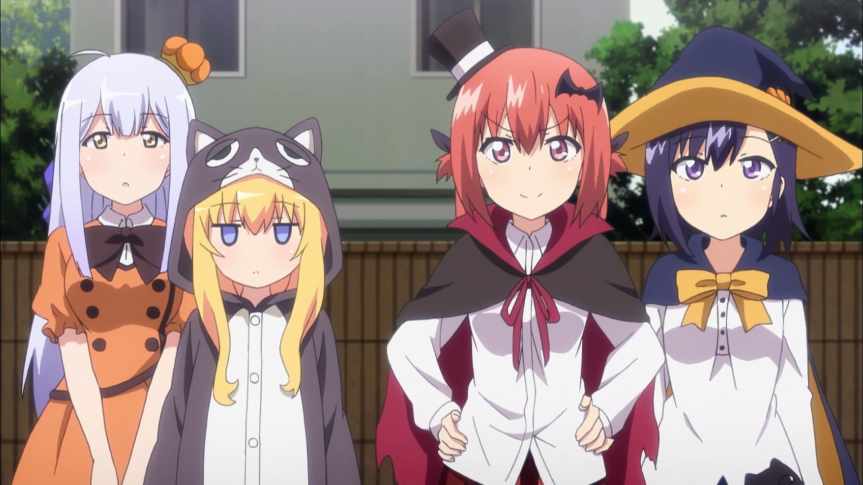
As something of an aficionado who has watched my fair share of these shows over the years, I believe I can identify certain rules, or perhaps principles, that work together as a formula to make an excellent harem anime. A harem anime might be able to get away with violating one or two of these rules and still be okay, but adhering to most of them is a prerequisite to being outstanding. Violating most of them is a near-guarantee that it’s going to be bad.

For the purposes of these rules, the character everyone is going ga-ga over is the “protagonist,” the assembled crew of those vying for him or her are the “harem,” and the individual members of that harem are romantic “options.” So, let’s get into it.

***

For the first 4 episodes, Invaders of the Rokujyōma takes on a relatively  slice-of-life/comedy bent as Kōtarō des… | Rwby anime, Digimon tattoo,  Sailor moon super s
Invaders of the Rokujouma

1. The 3/1 Ratio: The anime should have at least 3 episodes of runtime per romantic option.

Of all of the rules on this list, none is more commonly broken, and none is more commonly fatal from a quality standpoint. In a nutshell, some harem anime try to pack far, far too many romantic options into just a few episodes. The resulting problem is that none of them receives much attention, none of them gets much character development, and none of them makes much of an impression once the anime is over. Since anime creators rarely get to dictate the number of episodes their series will get, the better option is usually to intentionally limit the size of the harem.

By definition, “two is a romantic comedy, three’s a harem,” but the best-crafted shows in this genre keep their crew of girls or guys relatively small. That allows the viewer, along with the protagonist, to really get to know them, appreciate their quirks, and fall in love with them on a deeper, less superficial level. It also allows the romantic options to interact with one another as well as the protagonist across multiple episodes, reinforcing what we know about each character and why we should care about them. Harem anime that fail to follow this rule feel like a recording of a frenetic speed-dating session where we have trouble even remembering characters’ names, much less their personalities.

I will note that my “3/1 Ratio” is not exact math, and it is flexible in several ways. For one thing, it doesn’t mean that each option must receive precisely equal spotlight time in terms of their episode count, since some story arcs may necessarily take longer than others. It also doesn’t mandate exactly three episodes worth of individualized attention. In fact, this 3/1 ratio takes into account that you’ll normally have at least one “intro” episode where we meet everyone and one “conclusion” episode that wraps everything up, and those will almost always be equal-opportunity.

A great example of an anime that follows the ratio but also shows how it can be flexible is Invaders of the Rokujouma. It’s a 12 episode harem anime that also happens to coincide with the “exotic girlfriend” anime subgenre. With 7 recurring female characters, it seems to be radically exceeding the ratio at first, but one girl is a side character who is not at all romantically involved with the protagonist (moving us to 6), one is just a wingman for her friend (moving us to 5), and another functions as a sort of aspirational dream girl who receives a small amount of attention across all episodes rather than a dedicated storyline of her own (through this unusual loophole, moving us to 4). 4 options X 3 episodes “per” = 12 episodes, putting this anime in exactly the right sweet spot to comply with the ratio. It also includes one header, one trailer, and gives each girl in the harem exactly two consecutive episodes of spotlight time. By following the 3/1 ratio, we get to know all of them well enough to see why we should care about any of them.

Anime that did this right: Invaders of the Rokujouma; Fruits Basket; Majikoi; Ah My Goddess!

Anime that messed this up: If Her Flag Breaks (Gaworare); Are You the Only One Who Loves Me? (Oresuki); Maken Ki; Tenchi War on Geminar; Brothers Conflict

Otomate's Hakuoki Finally on Mobile Devices! – Figuratively Speaking
Hakuoki

2. Six or Seven is Plenty.

This functions as a sort of corollary to the previous rule when applied to longer series, because while the math certainly holds true on a shorter anime, it doesn’t mean that a 52-episode series should ever have 17 or 18 love interests to keep track of. Even in cases where you have a very long series with multiple seasons, it is almost never a good idea to create a harem of more than six or seven romantic options. Honestly, you probably get the best mileage out of four or five.

There might be a few isolated cases where this rule is bendable, usually in cases where the ridiculously vast size of the harem is the entire point of the series. (Hanaukyo Maid Team might be a good example of this principle.) In general, though, if you want your viewer to remember and care about your crew of romantic options, the smart approach is to focus on a manageable-sized cast.

Anime that did this right: Tenchi Muyo (original OVA, Tenchi Universe, and Tenchi in Tokyo); Ranma ½; Hakuoki; To Love Ru

Anime that messed this up: Negima; Sister Princess; Date A Live (by later seasons)

Boys Over Flowers - Anime dos anos 90 já está disponível na Crunchyroll
Boys Over Flowers

3. The Protagonist Should Be Lovable And Interesting, Too.

Other than the pervasive ecchi content, the other most common complaint about harem anime from people who don’t like the genre is annoyed mystification over the following question: “Why would anyone be fighting over this loser?” And all too often, they have a point.

Because there’s a sort of “wish fulfillment fantasy” element to harem anime (i.e. “Wouldn’t you like cuties fighting over you?”), some anime creators try to make the main character a potential stand-in for the viewer. Unfortunately, they often decide to accomplish this by making the protagonist as bland, boring, and uninteresting as possible. You know the type if you’ve watched many anime in this subgenre. When it’s a male protagonist, he has messy brown hair, always wears a plain white shirt, is never physically imposing, has no distinguishing features, is whiny and spineless, and his idea of “defending” a love interest is jumping in front of them with his arms outstretched as a disposable human shield. Female leads in “reverse harems” are slightly less cookie-cutter, but the default in such cases seems to be a clumsy, quietly-pretty (but not impossibly-pretty), slightly oblivious girly-girl with long hair who frets too much.

It is possible to have an “okay” harem anime with a bad or boring lead, since the harem can still be interesting enough to carry the show. But… why do that? A much better method is to make the main character not only likable, but unique and interesting. Offer the viewer compelling reasons why the harem characters love this guy or girl so much that they’d fight over them. That’s the only way you’ll get any genuinely heartwarming scenes out of the show, because viewers will be happy to see a couple get together when they respect both characters who make up the couple.

On top of that, an interesting, likable main character does not do harm to the wish fulfillment element of a harem anime. If anything, most viewers would feel much more flattered imagining themselves as the stand-in for a character they actually like and respect rather than feeling like they were being compared to a bland, personality-less no-name whose on-screen presence irritates them.

Anime that did this right: The World God Only Knows; Ouran Host Club; Boys Over Flowers; Ladies vs Butlers; My Teen Romantic Comedy SNAFU (OreGairu); Golden Boy

Anime that messed this up: To Love Ru; Maburaho; Heaven’s Lost Property; UFO Ultramaiden Valkyrie; Diabolik Lovers
Watch Happy Lesson | Prime Video
Happy Lesson

4. Love Can (And Often Should) Take Different Forms.

This is a rule that seldom hurts anything when it is not followed, but following it can absolutely make a harem anime more interesting than it would have been otherwise. In quite a few harem anime, the options all want to become the main character’s girlfriend or boyfriend and all find the same thing(s) about them attractive, and that can provide plenty of entertainment in its own right. However, it’s more realistic and engaging when there’s some variety in the attempted relationships being forged.

People are different – even fictional people – and they will likely find different things about a character impressive, admirable, or lovable. They will also have different needs in their lives that are not currently being met. Because of all of that, it stands to reason that what they like or what they’re seeking from the protagonist would also contain some variety. A member of the harem may love a character and feel jealous when it comes to their attention, but the relationship they are seeking out may be more platonic – that of a friend, a brother/sister/parent/child figure, or that of a professional mentor. This not only helps the sense of realism in the show, but also allows for richer and more creative plot elements than the entire harem simultaneously trying to get into the main character’s pants or skirt.

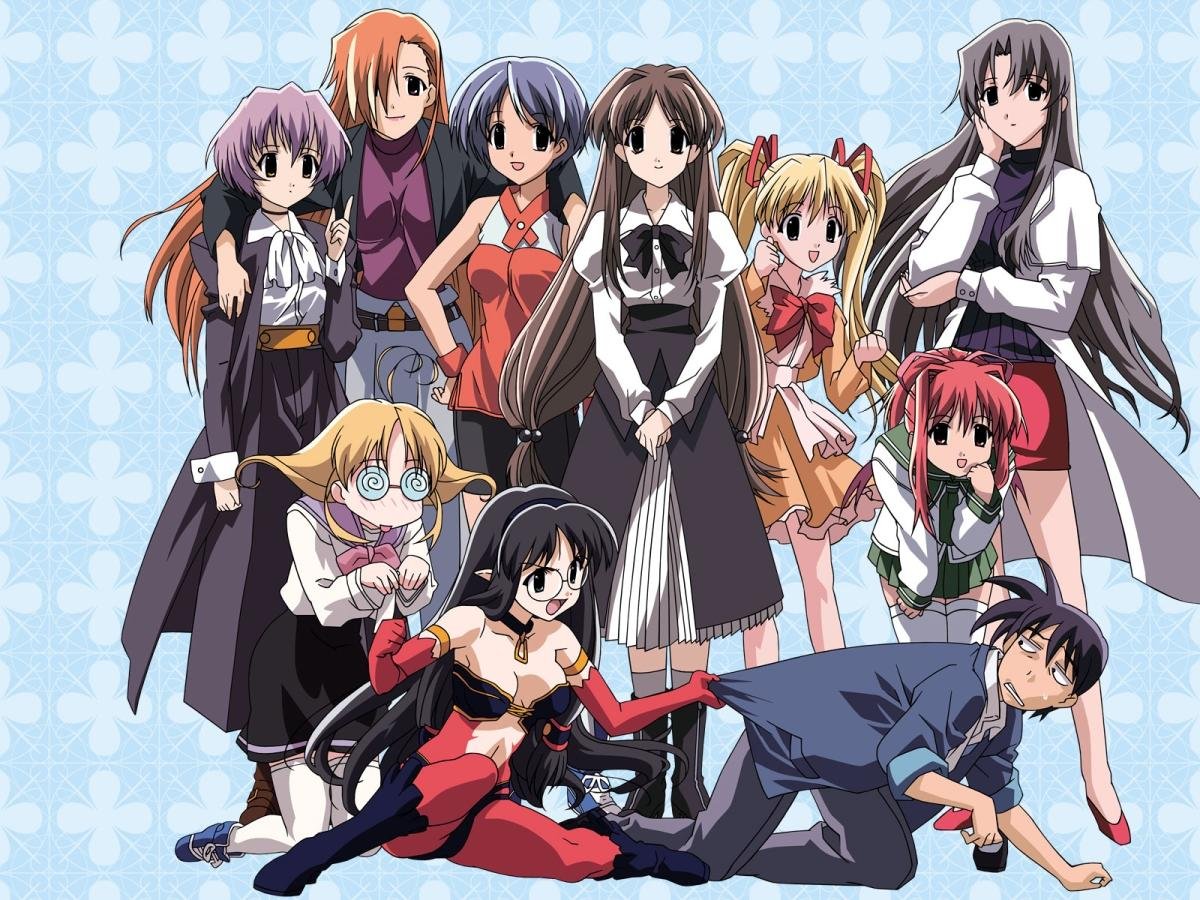
One of the most unique anime I can think of in this regard is Happy Lesson, which is about an orphan teenager named Chitose who suddenly has a gang of hot women in their 20s move into his home. The catch? They’re all his teachers at school, and all of them want to become his mom! The series does contain one or two characters closer to his age who like him romantically, but this unique, purely platonic spin on the “harem” concept elevates this otherwise-mediocre entry in the subgenre into something considerably more interesting and memorable.

Anime that did this right: Happy Lesson; Haganai; OniAi; Ah My Goddess!; Saber Marionette Series

Anime that messed this up: My Sister is Among Them (Nakaimo); Ah My Buddha; High School DxD

Imagem relacionada | Code realize, Anime, Coding
Code Realize: Guardian of Rebirth

5. The Protagonist’s Appeal Shouldn’t Be A Mystery.

This is related to both #3 and #4, but it’s important enough to merit mentioning on its own, and it’s also possible (albeit uncommon) to mess this up while getting those rules right. The romantic attraction between the protagonist and the options shouldn’t feel like it materialized out of thin air, nor should it feel like a completely unnatural reaction to a toxic personality.

This is usually a direct, straightforward reflection of good or bad writing. Ideally, you’ll have an interesting, likable protagonist whose appeal speaks for itself. Even in cases of a bland protagonist, though, an anime can still follow this rule if it has the protagonist do something positive on an option’s behalf to explain why they find him or her lovable. If they don’t do either of these things – if the protagonist has no inherent magnetism or charm, and if they do nothing to earn affection – and they have an entire harem fighting over them anyway, that’s a huge problem from a basic writing perspective.

It’s also possible for a protagonist to be too toxic for the harem to make sense. I have seen some anime where the writers tried to make the protagonist prickly to make them more interesting, but they were occasionally enough of a jerk that it strained credulity that many people would like them. (Takeya in DearS, an anime I quite enjoyed overall, was guilty of this in a few scenes.)

Unfortunately, a toxic male protagonist surrounded by women who fawn over him is more often a reflection of some pretty deep misogyny baked into the writing – the author’s belief that women are most romantically and sexually attracted to bad boys who treat them poorly. I won’t say that such women don’t exist in nature at all, because it’s a big world out there, but they’re pretty darn rare, and forming a harem around that concept just feels gross most of the time. In reality-world, both women and men generally save their warm, fuzzy feelings for those who make them feel loved and valued, and fiction tends to be better when it reflects that.

There is a rather unique loophole around this rule that can explain the harem’s attraction to a character who does nothing special, is nothing special, or has an abrasive personality – the “they’re after his genes” scenario. These aren’t common, but a few anime (ex. Maburaho, Peter Grill and the Philosopher’s Time) feature a harem based purely on sex where the options are not after romance at all. Instead, the protagonist has something special in their bloodline (usually some massive latent power) that the female cast members want passed on to their own descendants, which in turn requires making a kid with him. Such anime are almost always sky-high on ecchi content, tend to be rather silly, and generally don’t want you to take them very seriously… but one has to concede, it is at least a reason.

Anime that did this right: Ai Yori Aoshi; Shomin Sample; Hakuouki; Code Realize: Guardian of Rebirth

Anime that messed this up: Trinity Seven; Demon King Daimao; DearS
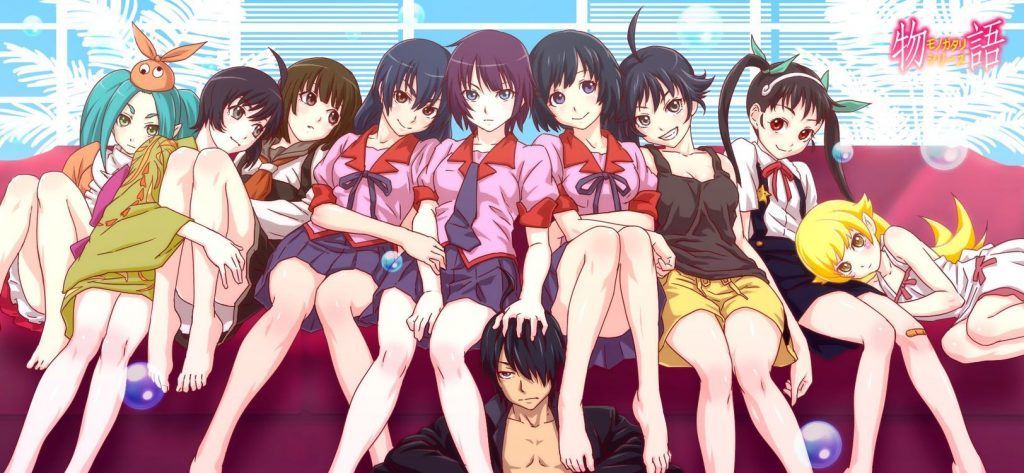
8 Harem Anime You'll Actually Watch For the Story | All Harem Amino Amino
Monogatari

6. Every romantic option should be a viable one.

Not a lot to say here, other than that a considerable amount of the dramatic tension of a harem anime revolves around a single question: “Who will the protagonist end up with?” If it’s almost a foregone conclusion from the very start and the only real question is how they’ll get there, you’re actually watching a romance anime, not a harem anime.

If it is a genuine harem anime, though, there shouldn’t be any candidates so much weaker than the others that it feels like they were never in the running at all. They don’t have to all have perfectly equal shots, but if it’s not a close race, it substantially lessens the dramatic tension and makes for a weaker show. If there’s only one candidate weaker than all the rest, that’s even worse, since it will cause the double-whammy problem of the audience feeling pity for them as well as being bored with the overall lack of romantic suspense.

There may be an isolated anime or two out there that break this rule without it substantially harming the quality of the series, but those are rare enough that I feel comfortable standing firm behind the general principle. Romantic tension makes for a better harem.

Anime that did this right: Infinite Stratos; Outbreak Company; Monogatari

Anime that messed this up: Ranma ½; Love Hina; Hand Maid May

Prison School - Episode 8 English Sub - YouTube
Prison School

7. Fan Service Is An Additive, Not a Substitute.

By “fan service” or “ecchi” material, we’re talking any lewd or naughty images the animators cooked up for the audience. There is often quite a bit of risqué material in harem anime, simply because the setup lends itself so well to sexy scenes, wardrobe malfunctions, and attempted seductions. (In fact, I’d go so far as to say that while not all harem anime are ecchi, almost all ecchi anime are harem. There aren’t too many shows where sex appeal is the main focus and a single character provides all of it.) And this isn’t necessarily a problem! There is certainly a place for risqué comedy and artwork in anime, and as long as it’s clearly identified by the rating, viewers can “take it or leave it” as they choose according to their tastes.

However, a problem arises when fan service is the only thing a harem anime has going for it. Even for a one-season anime, 12 episodes is a long time to suffer through an anime with a bad or meandering plot, poorly-executed comedy, and boring characters. No matter how sexily it manages to animate its cast, no matter how much time and money is blown on the “animation budget” (ahem), viewers still want a decent story to go along with it. At the very least, all things being equal, they would vastly prefer a story where all of those elements are also strong.

Note that “fan service” and good writing emphatically don’t need to be an “either/or” proposition. A series I would highlight as an example that proves the point by featuring a shocking amount of both is Ladies Versus Butlers. This series is lewd to its very core – its characters tend to look rather suggestive even when they are standing perfectly still or are engaged in normal interactions, and when it actually tries to be risqué, it goes way over the top. Despite that, it has a loveable cast, is well-written, and has many touching and laugh-out-loud moments. High ecchi content is not everyone’s cup of tea and might limit a show’s appeal for that reason alone, but the overall quality of Ladies Versus Butlers proves that it’s virtually impossible to over-spice good writing out of existence with fanservice. Provided it’s there in the first place, the good writing will still show through.

On the other hand, the second season of Maken-Ki proves that no amount of fanservice can replace good writing. The first season of this anime would win no awards for its disjointed and meandering plot, but it did at least make a weak effort at having one and was slightly better for it. The second season didn’t even bother, jettisoning any pretext of plot in exchange for “plot,” and it resulted in an anime season that had no more artistic value than any other embarrassing thing you’d want to erase from your search history.

Anime that did this right: Ladies Versus Butlers; Prison School; Monster Musume; Golden Boy

Anime that messed this up: Maken Ki; Mr. Nobunaga’s Young Bride; Mouse

The Quintessential Quintuplets Mobile Game Available Now
Quintessential Quintuplets

8. Production Values Matter.

This one may sound like an odd one to include, because it’s not unique to harem and is equally true of any anime genre. However, since we’re listing the rules of what it takes to make a good harem anime, I’d be remiss to not say that this subgenre benefits or suffers from its production values just like any other.

An interesting aesthetic, appealing and unique character design, beautiful colors and lighting, good animation, catchy opening and ending songs, and good background music can elevate a mediocre harem anime or make a great one shine even brighter.

A generic aesthetic, bland or off-putting character design, flat-looking or lazy artwork, stiff or no animation, forgettable opening or ending songs, and inappropriate background music can kneecap even a very well-written harem anime and make it forgettable or outright bad.

Anime that did this right: Are You the Only One Who Loves Me? (Oresuki); Grisaia series;Quintessential Quintuplets; Samurai Girls / Samurai Bride

Anime that messed this up: Rosario Vampire; Happiness; Love♥Love; Koi Koi Seven; To Heart series

***

And that’s it! I hope this tour through the philosophical underpinnings of silly romantic comedies about a crowd of girls or guys drooling over an “unlucky” protagonist has been useful to you. Candidly, I think it will be useful to me here at Anime Obscura as something I plan to point back to when reviewing harem anime in the future.

I feel I should mention one or two things in closing this little list. First, you may have noticed what seems like a rather glaring omission – the rule that “the harem options themselves should be lovable and interesting.” While absolutely critical, the reason I didn’t include that particular rule in this list is that it’s actually the one thing that harem anime virtually never mess up. Even the densest anime creators seem to understand that their harem characters are the life and soul of the genre, and even if they break all eight of my other rules, they get that one aspect right and create love interests that are at least somewhat interesting and feel like they have the potential to be lovable. If a harem anime goes wrong, the problem is usually not with the harem options themselves, but the fact that they were not fleshed out fully enough (rule #1 and 2) or that their relationship to the protagonist felt forced, illogical, or boring (rules #3-5). In the handful of cases where they serve no purpose other than eye candy, they violate rule #7. Between all of that, I felt like enough bases were covered that this didn’t need to be listed as a separate rule. If anyone wants to make it an apocryphal ninth rule, though, I have no problem with that.

I should also stress that I can only mention shows here that I have personal experience with or knowledge of. There may be other anime that would serve as better examples of breaking or following these rules, but they just aren’t in my repertoire at this time. I also have to admit that while I have watched most of the anime I mentioned here in their entirety, there are a handful (especially among the “bad” examples) where I’ve only watched an episode or two and formed my opinion based on that. If I’ve falsely inflated or sullied a particular anime’s reputation, you have my apology in advance. I still stand firm behind the general rules I’m advancing even if I were to make a minor goof on a “case-in-point.”

Finally, I’ll close with the usual disclaimer about how every rule has exceptions, and about how it’s possible to break the rules and still have things work, yadda yadda yadda. You’ll notice that some anime I singled out as problematic in certain areas were featured as exemplary in others (Oresuki and Ranma ½), and a few of the ones I have pointed out as having problems are nonetheless “Top 10” anime for me overall. It’s very possible for a harem anime to still be outstanding thanks to its overall merits even if it gets one or two aspects of the overall “perfect harem anime” formula wrong.

All the same, I’ll be happiest when they get all of it right, because if the harem genre teaches us anything, it’s to shoot for the moon in terms of our expectations. After all, why settle for one good thing when you can have it all? 😉

Are You The Only One Who Loves Me? / Oresuki

ANIME REVIEW: Take the X Train

I feel certain everyone has had one of those “midnight movie” experiences where you’re looking for something to watch for a few minutes before turning in for the night, but stumble across something so weird that you wind up sticking with it all the way till the end credits, only to wonder if what you just watched was actually real at all. I had pretty much that experience last night with Take the X Train, a bizarre short movie from the golden era of high-budget 1980s anime. The high production values could have made it an internationally-renowned classic, but I suspect it never made it that far because it’s so damn weird.

The plot of this anime movie is honestly not the easiest thing to piece together, much less summarize, but it essentially tells the story of a seemingly-normal guy named Toru who works as an unappreciated peon in the marketing wing of a Japanese railway company. Out of the blue, he starts having intense nosebleeds while spacing out and imagining the whirring gears and levers of a dark train. One evening after a night out with his girlfriend, he goes to a subway and has a paranormal encounter with an infamous ghost train, which the media dubs the “X Train”. The X Train is seemingly made out of pure electricity and can mainly be seen through two electric sparks that resemble the front wheels of a train traveling down the tracks, trailed by lightning, and it leaves a power surge like a huge EMP in its wake. After excitedly telling his circle of friends and coworkers about the encounter, Toru is kidnapped by a strange government agency that seems to believe he has ESP and some sort of connection with the X Train. They force the goofy Toru against his will into a battle against this spectral, psionic locomotive, with results about like you might expect… only not.

It’s hard to know where to begin talking about this movie, but the music might be a valid jumping-off point. It opens with a dedication to Duke Ellington, whose famous “Take the A Train” is referenced in this anime’s title. Ellington’s jazzy, off-kilter piano music also provides the soundtrack for the anime, and it feels oddly appropriate in highlighting the absurdity and mismatch of protagonist and antagonist. The animation quality is extremely high in this film, with some of it rivaling the best work done by masterpieces of the same period like Akira, Wicked City, and Demon City Shinjuku. It also has a similar fascination with body horror. I can’t get into the most notable example without major end-of-movie spoilers, but Toru’s throbbing temples and nosebleeds when having his extrasensory connections with the X Train are a good minor example of the unsettling gross-out visuals one would find in a movie with that focus.

I would be remiss if I didn’t also say that this movie can be incredibly funny at times. Some of the more juvenile humor lands flat, but some of the funniest moments involve things as small as an animation of Toru’s eyes roaming from left to right after something otherworldly has happened, all the while keeping this goofy-ass perplexed expression on his face. The art style is also fairly unique. There are no attractive-looking characters in this anime; every single character design displays a hint of the grotesque in their caricatured expressions, but at the same time reflecting more realism than most anime in reflecting how people actually look. Finally, Toru himself is a thoroughly likeable main character, an everyman with enough pluck to make him admirable but also lame enough to make him funny and relatable.

So, why is this movie so thoroughly unknown, and why did it never even receive an official release in the West outside of a fandub? I can think of several reasons, frankly. First and foremost, this anime is defiantly odd in a way that will certainly appeal to some people (me included), but the humor of a subtle sort that would fly straight over the head of about half of its audience and might not appeal to another half of that group where it actually landed. Its art style is a similar acquired taste, as is its music. Duke Ellington might be a critical legend and beloved by jazz aficionados, but experimental, free-form, discordant piano music is not usually showcased in movie soundtracks for good reason. Soundtrack music generally functions as a way to accentuate the emotions present in a narrative. In this film, it feels like a way to highlight how creative artists (both Ellington and those who made this movie) can do whatever the hell they want, and you can take it or leave it.

More than anything, though, I suspect that Take the X Train never achieved the same level of critical success as its peers because its humorous ethos refuses any pretext of self-importance. Akira makes an excellent counterpoint in this regard. Akira wants you to take it very seriously, and its production values, music, and style – which almost mixes cyberpunk themes with Lovecraftian “horror of the unknown” – all work together to cement a solid argument for that expectation. Does it all work together as a logical whole with no loose ends? Perhaps yes, perhaps no. But enough is left spookily vague and suggestively “important” that we want to give it the benefit of a doubt. Take the X Train works on an entirely different wavelength. The exaggerated art style, the goofy protagonist, the odd musical choices, and its profound sense of the absurd all seem to imply that “We don’t take ourselves too seriously, and neither should you.” And yet, I can’t help but feel that this is a red herring bait that we shouldn’t take. Take the X Train actually does have some deep things to say: about the helplessness of an individual against an oppressive system, about the role of the underappreciated worker in society, about how doing the right thing is worthwhile even if it doesn’t always promise a good result. But where this movie is concerned, these will forever be deep truths wrapped in a really elaborate joke. And as with most good comedy that contains that, many in the audience will gulp down the joke without ever even tasting the hidden truth below the surface flavor.

Take the X Train is “anime obscura” of the best kind – one of those odd little hidden gems that would be great to invite a few good friends whose taste in humor and understanding you think highly of to watch with you and talk about afterward. Plus, at only 51 minutes, it isn’t a high “ask” in terms of runtime. A big thank-you to the Roku Channel The B-Zone for introducing it to me. You can also find the subtitled movie for free on YouTube currently at the link below.

Take the X-Train (Fandubbed Movie)

Take the X-Train (IMDB page)

Finally, if you enjoy Take the X Train, it’s worth noting that its primary creator (writer/director Rintaro) did go on to other, more successful projects — most notably, the anime adaptation of the silent classic Metropolis.

ANIME REVIEW: Fate/stay night (2006)

The anime I’m reviewing today hardly qualifies as “obscura,” but it has been so eclipsed by its more recent remakes and spin-offs that the original isn’t as well-known or well-respected as it once was. Undeservedly so, in my book! So let’s summon some heroic spirits and shine a spotlight on the 2006 anime adaptation of Fate/stay night, which helped springboard a humble indie visual novel into the now-sprawling Fate series of anime and video games.

Tracing the chronology and history of Fate could be a humongous undertaking, but to kick things off here, just know that Fate/stay night was originally a visual novel created and published by the Japanese game company Type-Moon back in 2004. In 2006, it received a 24-episode anime adaptation from Studio Deen that removed the game’s adult content and unified the game’s three branching paths into a single storyline. That anime is what we’ll be discussing today.

Fate/stay night opens with a mysterious girl named Rin Tosaka performing a magical rite to summon a tall, tanned warrior, nearly destroying her house in the process. It then quickly cuts away from Rin to introduce us to Shiro Emiya, a cheery and very deliberate “do-gooder” teen who was the only survivor of a catastrophic fire that struck his neighborhood when he was a boy. The man who saved and adopted him later died, leaving Shiro alone in his near-palatial house. He lives a fairly normal and happy life thanks to a female classmate and friend who helps him with cooking and chores (Sakura) and his wacky homeroom teacher and big-sister figure (Taiga), both of whom eat breakfast with him every morning. Aside from his tragic origins, the only other unusual thing about Shiro is that he knows and can use a little bit of real magic, having been taught some beginner spells by his late adoptive father. Shiro’s peaceful life is suddenly shattered when he stays late after school and sees Rin and her warrior, Archer, battling with another strange warrior named Lancer. Being a witness to this event puts a target on Shiro’s head, and Lancer is on the verge of assassinating Shiro to keep him quiet when Shiro accidentally summons a warrior of his own, an intimidating blonde woman in armor named Saber.

After some dust settles, Rin explains to Shiro that he has stumbled into a contest called the Holy Grail War that pits seven teams of sorcerers (magi called “masters”) and their summoned warrior spirits from the past (called “servants”) against one another in a battle royale. Once the fray of contestants are reduced to a single master-servant team, the Holy Grail will materialize, and master and servant are each granted a single wish by the Holy Grail. Shiro’s status as a master is a big surprise to both him and Rin, because an amateur magus like him was highly unlikely to become a master in the first place, much less be able to summon a servant as formidable as Saber. Shiro reluctantly agrees to participate in the Holy Grail War, mainly to prevent a repeat of the disaster that almost claimed his life ten years ago. Friction soon arises between Shiro and Saber due to the incompatibility between his relatively pacifistic “wait-and-see” approach and her warlike seriousness, and his lack of ability as a magus means Saber cannot heal from injuries as quickly or reliably as other servants. Still, as deadly new masters and servants make their moves and the danger level grows ever greater, a mutual dependence, respect, and something perhaps greater than respect grows between Shiro and Saber. It is an open question, however, whether even that bond will be enough to help this mismatched duo survive a war where every other contestant is either an experienced sorcerer or the spiritual reincarnation of one of history’s greatest heroes.

This anime was my own personal introduction to the Fate series, and because it has a reputation of being a difficult series to get into, I was concerned that I wouldn’t be able to follow along. These fears proved unfounded, thankfully. The great thing about Fate is that while it contains its own unique glossary of terms, the concepts behind those terms are seldom hard to understand. (If you want to be fancy and say “noble phantasm” instead of “special attack,” guys, it’s no skin off my nose.) The original Fate/stay night is also extremely well-paced. Characters are introduced at a steady rate where none feel like throw-away cameos, and once introduced, they pop in and out of the action in a way that keeps them on your radar while feeling natural and unforced.

The cast of characters is one of this anime’s strongest points, and I appreciate how low on stereotypes it is. Shiro is self-sacrificing and has an innocent soul, but he’s a creative and unflinching fighter who doesn’t intend to go down easily. Rin is aristocratic, brainy, and sharp-tongued, but she is also eminently reasonable. I also had to smirk at how much of a born educator Rin is. She can seldom resist teaching Shiro any time she notices him getting something wrong, even when it might be to her own detriment later on. Saber is virtually unique in anime in the unbridled sense of nobility and awe that the series imbues her with. She is not a ditz, not a tsundere, not a goofy scrapper, but a cool-headed badass who simultaneously takes your breath away and raises the hair on your neck. You get a sense that if a crew of super-powered spirits were out to kill you, you’d be immensely relieved to have this fearless warrior as your sword and shield. Even Fate‘s more minor characters tend to be multi-dimensional, and that human complexity keeps the plot fresh and unpredictable.

I also wanted to briefly mention here in the spoiler-free section of the review that the chemistry between characters is also a high point of this series. These characters change and develop not only from their experiences and struggles as the series progresses, but also from their interactions with each other. The relationship between Shiro and Saber is the true focal point of this particular Fate anime series, and there’s a constant low-level friction there that’s engaging to watch unfold. Until the middle of the series, the two don’t get along at times because their approaches seem too different. In the second half, a different kind of friction arises when they realize that they are problematically similar in other respects, and they keep trying to correct their own fatal flaw in each other. I also loved watching Rin’s single-minded ruthlessness as a mage become diluted by the humanity that Shiro introduces into her worldview. I could go on, but I would prefer you see and enjoy the rest for yourself.

One area where the 2006 Fate does suffer a bit in comparison to its successors is in the visuals. Understand me, the original Fate/stay night does not look bad by any stretch of the animation. The artwork is frequently gorgeous, and the character designs are extremely appealing. However, the animation is nothing to write home about and occasionally verges on looking a bit cheap by modern standards. There is also a fair amount of reused animation – some flashbacks, especially Shiro’s memories of the fire, get replayed verbatim several times during the series. This anime’s visuals hold up quite well when compared to most other anime produced in the same mid-2000s period, and it does some particularly pretty work with lighting at times. However, it is nowhere near the sky-high visual bar set by the remake, prequel, and spinoffs produced a few years later by Ufotable (Fate/stay night: Unlimited Blade Works, Fate/zero, etc.). That doesn’t mean those later ones are better all-around anime – the 2006 version is still my favorite telling of the Fate story thus far, as I’ll explain later – but it does mean you shouldn’t go into this one with visual expectations set by those later versions, or you’ll likely be disappointed.

The music is interesting in that it’s a bit sparse, but everything that is here is excellent. You’ll hear the same tracks reused pretty frequently, but it’s all memorable and very appropriate to the scene. It reminds me of the kind of music I have heard in actual-factual visual novels in the past. I don’t know this for sure, but I wonder if this was done intentionally as a nod to Fate’s origins in that genre, or if perhaps the anime lifted some music wholesale from the original visual novel. Speaking of the visual novel connection, I found it amusing that I could easily pinpoint one or two parts in the anime’s story that had obviously contained steamy bits in the original “18+”-rated visual novel.

I want to talk a bit about the ending, but I want to do it in a way that avoids spoilers for those who haven’t yet watched this series. My spoiler-free summary is that the ending didn’t deliver everything I was hoping for, but it was perfectly palatable, it was very touching, and it did nothing to harm my enjoyment of the series as a whole. More detailed comments with some *MAJOR* spoilers follow, so skip the text starting below Taiga and start reading again after the Fate/stay night logo if you want to avoid those.

Image result for fate stay night 2006 berserker

My only real gripe about the ending was that it felt thematically inconsistent with the key lessons the series seemed to be building toward from the very beginning. From Episode One onward, we find that part of Shiro’s character is that he thinks virtually nothing of self-sacrifice, whether it’s in big things or small. He wants to be a “hero of justice,” and his conception of that involves always thinking of others first and himself last, if at all.

This personality trait of Shiro’s irritates Saber to no end, and his personal recklessness makes it nearly impossible for her to protect him. We soon discover that this is a case of people who are altogether too similar wearing on each other’s nerves, however, because Saber has just as serious a martyr complex as Shiro does. She tries to fight even when on the verge of death, at one point claiming that “as long as I have my head, I can fight on.” The same single-mindedness of purpose was also a defining trait of hers in her original life as Arturia Pendragon, or King Arthur, to the point that it was misunderstood by her people as a lack of humanity. Even her motivation in the current Grail War is connected to this – believing she failed the people of medieval Britain when Camelot crumbled, she wants to go back to the past and have someone else, someone “better,” chosen as king.

During the course of the story, Shiro and Saber eventually develop feelings of love for one another, and you can see both trying to talk each other into thinking of their own happiness for a change while stubbornly refusing to take their own advice. Saber worries for Shiro and doesn’t want him to get killed. Shiro loves Saber and wants her to live out a happy life in the present rather than throwing it all away to change the past. The anime seems to be building toward two key morals: that one should live for the future rather than the past, and that it’s both okay and healthy to have some regard for your own happiness, because an absolute lack of care for yourself leads a person down a self-destructive path that brings misery to everyone who loves them. This lesson reaches its climax in the second-to-last episode when Shiro and Saber both individually reject the priest Kirei’s temptations to sacrifice themselves or each other for the chance at having the Holy Grail undo their greatest regrets.

However, just as soon as this thematic resolution is reached, we have the rug pulled out from under us by the revelation that the Holy Grail was merely a weapon of apocalyptic power, and that it never had the ability to grant wishes of that sort in the first place. Furthermore, Shiro and Saber are caught in a virtually unwinnable situation where the best possible outcome only means averting a cataclysm but still having Saber fade away. The duo achieves their goal through a combination of courage and love, but that outcome is still the best they can manage. Saber fades from this point in the timeline, only to awaken briefly in her medieval timeline right before her death as Arturia, her happy memories of Shiro allowing her to pass from this world at peace. Shiro, for his part, is not bitter but only has his memories of Saber to hang onto.

It’s bittersweet, and presented in such a respectful way that it’s hard to be mad at the series for the way it played out. However, suddenly shoehorning our main characters into such a fatalistic “no-win” situation at the end did feel inconsistent with the themes it had been building toward until that point. The bulk of the emotional drama of the series prior to that had all been about Shiro and Saber exploring the boundaries between a conscious choice to embrace a future happiness and their feelings of obligation toward loved ones in their pasts. To suddenly drop the bomb that there had never been a real “live option” in the first place felt both jarring and a bit cruel. I guess you could say that it was consistent in having Saber and Shiro fight courageously despite knowing the situation wasn’t winnable – that felt very in-character for both of them – but I think I would have preferred a happier ending where they had a choice. Then again, maybe that’s just my unfulfilled wish to see those two living their lives as a happy couple speaking from behind a mask of logic. Either explanation is definitely possible!

It’s tempting to write off Fate/stay night (2006) for various reasons. Anime with the “battle royale” setup have proliferated over the past 15 years to the point where casual viewers might be tempted away by newer options. Likewise, there is a multitude of Fate series with higher production values that one could launch into, such as Fate/stay night: Unlimited Blade Works, Fate/stay night: Heaven’s Feel, Fate/Zero, Fate Grand/Order, Fate/Extra, or Fate/kaleid liner Prisma Illya, most of which don’t require prior knowledge of Fate/stay night to understand. You could skip over the original Fate/stay night (2006) for all of those reasons… but you really shouldn’t.

You should start right here because the element of discovery plays out more organically and powerfully here than anywhere else. You feel genuine surprise at learning the original identities of Saber and the other servants, you feel moved by Shiro’s unfolding tragic past and Rin’s and Saber’s character growth, and you feel shocked when you learn the full truth about the Holy Grail War. If you start anywhere else in the franchise, you’re going to have various parts of this great story spoiled for you. This iteration is also the only one that tries to incorporate plot elements from all three of the possible branching storylines of the original visual novel (the “Fate”, “Unlimited Blade Works”, and “Heaven’s Feel” arcs), making this the most comprehensive single telling of the story you’re ever likely to see.

Image result for fate deen vs ufotable

On top of that… controversial opinion time… I found that I simply enjoyed Fate/stay night (2006) a lot more as a viewing experience than its most direct one-to-one competitor adaptation, Fate/stay night: Unlimited Blade Works, and I believe I can attribute that to three things. First, the pacing is better in this version — I didn’t have to suffer through what felt like 7 episodes of Archer kicking Shiro in the face and shouting at him that his ideals will destroy him, or an epilogue that felt a whole 2 episodes too long. I also found most of the cast more likeable, more unique, or both in the 2006 version. This version of Shiro can be a bit stupid at times, but his naivety is endearing in other ways. I thought the UBW Shiro felt rather flat by comparison, and it felt it odd and annoying how he became so inexplicably good at fighting from out of nowhere. UBW Saber was often riddled with self-doubt, and she lacked a certain quality of awe that feels central to the character here. More than any other character, though, Rin Tosaka suffered the worst downgrade between the two adaptations. A mature, bitingly sarcastic young woman with a mentor’s heart in the original, UBW saw her make a disappointing transition to an immature, one-dimensional tsundere who could have been cut-and-pasted from any other anime, and who actually had far less character as a teen than she did in her appearance as a little girl in Fate/Zero. Finally, on a purely personal note, I found the chemistry between Shiro and Saber in the 2006 version far more interesting and engaging than UBW‘s focus on the relationship between Shiro and Rin.

Before anyone starts ripping me a new one for the heretical paragraph above, understand that my preference for the original is just one man’s opinion, not an immutable law of the universe, and it should be viewed in that light. I had an excellent time with both Studio Deen’s original Fate/stay night and Ufotable’s Unlimited Blade Works, but for mostly different reasons. All versions of Fate Stay Night contain some combination of fantasy action and human drama. UBW focused more heavily on the action element and excelled beyond all expectations in that department. Its fight scenes are amazing, and its swordplay and explosions blow its predecessor out of the water. The drama, the plot, and the character-building are the aspects I personally find more interesting, though, and I felt the original exceeded the remake in those areas. Bottom line: a person who enjoys one will likely still have a very good time with the other, because they are different anime in ways that go beyond their diverging plots. (… But you should still watch this version first.)

At any rate, you know what you have to do, magus. Summon this show to your streaming service of choice, and command it to play. Once you finish the final episode, I think you’ll agree it was time very well-spent. At the time of writing, the 2006 Fate/stay night is available to stream on Hulu, HiDive, VRV, and Tubi. Collectors of physical media should note that the series has been in-print in some form or fashion for a very long time and changed distributors several times, and DVDs from Geneon, Funimation, or Sentai Filmworks are easy to find on the used market for a reasonable price. The single best physical release so far was a 1080p Blu Ray released by Sentai Filmworks in the mid-2010s, but that particular edition can be a bit expensive and hard to find these days.

Five Must-Watch Halloween Anime (Bite-Sized Edition)

The spooky season is upon us, and this is the perfect time to binge some horror-themed or supernatural-themed anime to get in the mood for Halloween. With that said, there are only so many hours in the day, there are tons of anime that would fit the bill, and October is almost half-over! What’s an anime fan wearing a witch’s hat or hockey mask to do?

Luckily for you, Anime Obscura has curated a list of quick anime watches that fit the bill. These are all selections of episodes from longer series that don’t require a ton of prior foreknowledge. If you enjoy this sampling, be sure to put them on your list to check out later… maybe in November. (To the best of my knowledge, there is a marked lack of turkey-themed or Thanksgiving-themed anime, so you’ll need something to tide yourself over till Christmas.)

Before anyone gives me the Freddy Kreuger treatment for omitting Higurashi: When They Cry or your favorite horror anime of choice, keep in mind that there are going to be some fantastic horror-themed anime that won’t make this particular list, sometimes because they’re too long to qualify as bite-sized, sometimes because I haven’t watched them personally… and sometimes because a guy has to stop typing sometime.

So, let’s get with it, ghouls and guys!

Ranma 1/2 Episodes 73 and 140 (“My Fiance the Cat” and “Pick a Peck of Happosai”)

Let’s start things off on a light note… For anime watchers of a certain age, Ranma 1/2 needs no introduction, but the main points an unfamiliar viewer really needs to know are that Ranma is a powerful teenaged martial artist who is cursed to change sex every time he’s splashed with hot or cold water, and he’s semi-unwillingly engaged to a girl named Akane, whose family he and his dad now live with. A bevy of cute girls and weirdos who love or hate Ranma constantly make their lives difficult, and the biggest weirdo of all is Ranma’s dad’s evil martial arts master, a two-foot-tall panty thief named Happosai. Oh, and as an “important-only-for-here” aside, Ranma is deathly afraid of cats, and overexposure to him causes him to go into a berserk psychotic state.

In “My Fiance the Cat”, Akane becomes haunted by an amorous ghost seeking a bride. Ranma ain’t afraid of no ghost, but when the ghost becomes visible and turns out to be an 8-foot-tall ghost cat, he becomes pretty much useless.

In “Peck A Pack of Happosai”, the Ranma 1/2 gang discovers that messing with the occult has consequences. A couple of misplaced tarot cards cause Happosai to be split into multiple supernatural personas — a knight, a witch, a centaur, a vampire, an angel, and a devil. Ranma and company have to figure out how to re-seal this horrible horny horde before they destroy the city or maybe even the world.

Ranma 1/2 is streamable subbed or dubbed for free (with ads) on Vudu. Episode 73 is part of Season 4, and Episode 140 is part of Season 7.

Dusk Maiden of Amnesia – Episodes 1 and 6 (“Ghost Maiden” and “Maiden of Vengeance”)

Dusk Maiden of Amnesia is my all-time favorite anime, not least because of the clever ways it explores how strong emotions, rumor, and belief all function together to make the phenomenon of ghosts possible within its world. The series follows a high school’s “Supernatural Investigation Club” whose club president (Yuuko) is actually a ghost herself, seeking answers about her dimly-remembered past. Only the main protagonist (Taiichi) and a distant relation of hers (Kirie) can see her, while the club’s most enthusiastic member and comic relief (Momoe) is blissfully unaware of her presence.

The first episode is necessary viewing to meet the members of the club and get a sense of what each of them is like and how they interact with one another. The sixth episode, “Maiden of Vengeance”, is the closest thing to a stand-alone horror tale that this series contains. The Supernatural Investigation Club is still poking around the school, trying to figure out if Yuuko is the school’s only ghost, when a girl who is an apparent paranormal-skeptic starts spreading a rumor out of the blue that quickly metastasizes into a full-blown panic among the student body. Her tales of a bloody executioner named Akahito-San roaming the school is making people act crazy with fear… and she seems to be encouraging this for some reason.

The entire 12-episode series is outstanding Halloween viewing, but these two episodes can be watched by themselves as a great snack-sized sample.

Dusk Maiden of Amnesia is streamable on HiDive or VRV.

Princess Resurrection – Episodes 1 and 13 (“Princess Resurrection” and “Princess Sacrifice”)

Princess Resurrection is another fantastic anime whose 26-episode entirety makes for good Halloween viewing, but in keeping with our promise to keep this bite-sized, I’ll recommend episodes 1 and 13.

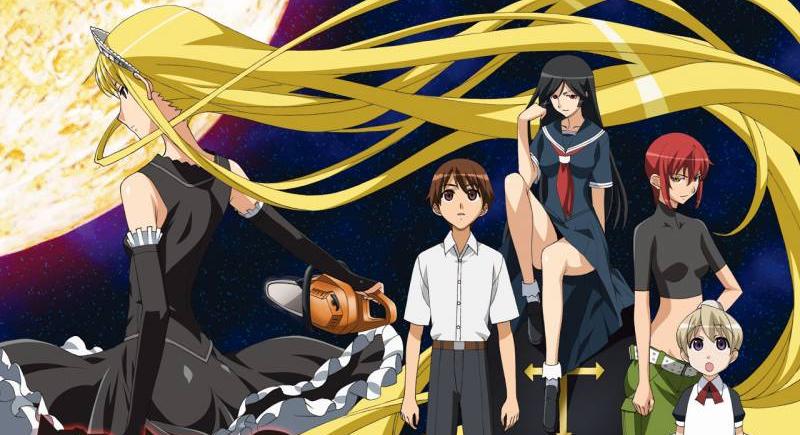
Episode 1 introduces us to our main protagonist, Hiro, who has traveled to a remote town to visit his sister, an airhead who has taken a job as a maid at a creepy Addams-Family-style mansion on the mountain overlooking the city. While in town, he sees a disaster about to befall a beautiful blonde girl dressed all in black, and in pushing her out of the way, he gets himself killed. Series over! (Okay, not really.) It turns out that the blonde, Hime, is his sister’s employer, and something of a literal princess of darkness. She resurrects him to a form of semi-life, but that comes with a bit of a price and a lot of trouble, as you and he will both soon find out.

Plenty of episodes in Princess Resurrection make for great October viewing, as they’re packed to the gills with monsters, vampires, zombies, Lovecraftian beasties… you name it. However, Episode 13 always stuck out to me as being particularly suspenseful and fairly unique for featuring an “unkillable slasher” villain a la Michael Myers, Jason Vorhees, or Leatherface. (For whatever reason, that trope is almost never used in anime apart from a humorous reference.) In any case, Hiro and Hime find themselves alone in an otherworldly village where one such monster holds bloody sway over the inhabitants. It’s genuinely creepy, and good stuff.

Princess Resurrection is streamable on HiDive or VRV.

Another – Collected Manga or Episodes 1-4

Another has often been nicknamed “Final Destination: The Anime”, and that description certainly isn’t wrong. Death itself seems to be stalking a group of high schoolers, with ordinary accidents turning lethal at the drop of a hat. The reason why is gradually revealed over the course of the entire series, and it would be a disservice to you to try to explain it to you here in summary form. It is clever, though, and feels like a worthy payoff for the most part. It’s also probably the goriest anime I’ve ever watched, bar none.

It’s worth noting that Another actually started off as a novel, then got adapted into both an anime and a manga shortly thereafter. Personally, I would actually suggest the collected all-in-one manga from Yen Press as the best way to experience this story. Being a comic, it’s a fairly fast read, and it explains a couple of things (especially about the ending) better than the anime did. However, unlike the anime, you can’t exactly “stream” a graphic novel and may not want to plunk down $30 on a lark, which is totally understandable. In that case, the anime absolutely won’t disappoint in terms of intensity and violence.

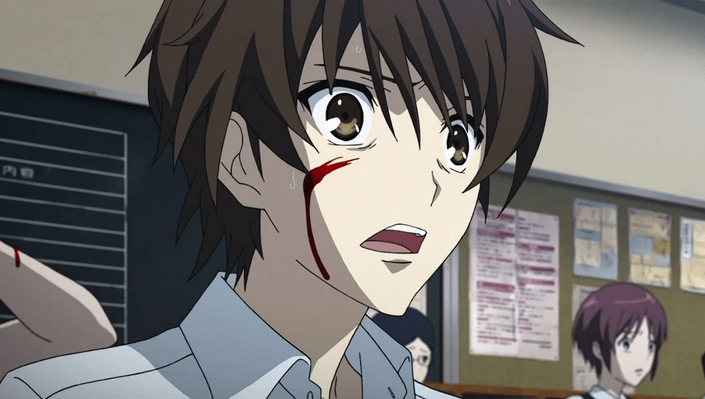
The first four episodes introduce us to Koichi Sakakibara, who has recently moved to a remote town in the Japanese countryside. His classmates seem oddly standoffish, as if his presence there is unwelcome, but not due to anything against him personally. At the same time, he takes notice of the fact that he keeps seeing a pale girl at the school wearing an eyepatch who none of the other students seem to see or acknowledge. Soon afterward, strange and horrible accidents begin befalling his classmates. Could the silent, ghostly girl be the cause? Or is there something else afoot?

Episodes 1-4 absolutely won’t explain the weird situation Koichi finds himself in, but it does give you an idea of the overall flavor of the anime and serves as a good jumping-off point should you wish to pursue it further.

Another is streamable on CrunchyRoll, HiDive, or VRV.

Ghost Hunt – Episodes 18-21 (“The Blood-Stained Labyrinth Parts 1-4”)

Ghost Hunt is a great anime with a simple premise and a very episodic nature, which makes jumping into a spot in the middle of the series easy as long as you know the setup. It follows the exploits of a group of ghost hunters and exorcists with a huge diversity of backgrounds and strengths. You have a paranormal researcher, an onmyoji (magic practitioner), a Buddhist monk, a Shinto priestess, a Catholic Christian priest, and a psychic, all of whom are loosely aligned as friends who help each other out on exorcism “jobs.” Joining them is our protagonist, Mai, a high school girl who made herself useful to the team in the first few episodes and started working with the paranormal researcher as his part-time assistant.

The team takes on a number of different cases during the anime series that get resolved over a number of episodes. Sometimes these involved solving a mystery but were not terribly dangerous, while others featured a supernatural threat that was actively harmful. Nothing before or after touches the Blood-Stained Labyrinth in terms of its deadly threat level, though. The team travels to a huge estate where people have simply been disappearing without a trace. The house is a massive complex with secret passages, dead-end halls and doorways… et cetera. It’s the labyrinth of the title. The kicker here is that these missing people have been gone for far too long to simply be playing hide-and-seek. And if the team isn’t careful, they may be added to the number of the house’s victims shortly… This story arc feels almost like an anime adaptation of The Shining or Hell House, and it’s great viewing. Without giving anything away, I also appreciated how this particular case wrapped up.

Ghost Hunt is streamable on the Funimation Channel.

***

So, there ya go, five anime selections to keep your Halloween spirit alive… or dead… or undead… however you prefer, really… in 2020. There are plenty of other anime and even other episodes I could have included, but hey, there will be other Halloweens and hopefully other Halloween-themed anime articles to write.

Take care, everyone! Stay safe, and may you always get nothing but the good stuff in your trick-or-treat bag!

ANIME REVIEW: The Devil Lady (Part 3)

NOTE: This is the conclusion of Anime Obscura’s coverage of the anime The Devil Lady. We will be delving into major spoilers this time, so be advised.

devil lady - asuka transformed 1

Last time we looked at how The Devil Lady portrayed a depressingly true-to-life depiction of how society would splinter were its premise to become a reality. This time, we’ll wrap things up by talking about the ending and how the anime provides an amazing character chemistry between Jun Fudou and Lan Asuka.

If the first half The Devil Lady is a story of Jun Fudou performing a scary balancing act between her two alter egos, the second half of the anime is one long, heartbreaking process of loss. As society begins falling apart, Jun’s personal life follows suit, and she gradually loses everything in her life that mattered to her. She loses her home—this former safe space gets destroyed by a cabal of violent devil-beasts. She loses her job and the work-relationships she had come to treasure as part of her identity. Her friendship with Kazumi splinters as the two part ways, with the younger model needing time to process the truth about the older woman she adored. She ultimately even loses her freedom as Lan Asuka and her former allies among the human commandoes isolate her, jail her, and ultimately use her as a lab rat. Finally, in the lead-up to the final battle, Jun loses everything and everyone she ever cared about, and she quite literally abandons her humanity, cutting her hair and declaring that, “I will never be human again.”

As all this has been happening, Jun’s powers as the Devil Lady have only been growing. To meet the threat of each new devil beast, she becomes stronger, faster, and tougher; develops new abilities such as an electric shock; and gains greater control over her powers of flight and her kaiju-sized “giga” form. With this explosion of power happening alongside a total emotional breakdown, you keep waiting for Jun to explode in violence at the unfairness of it all and lash out at the world. What actually happens is that Jun’s self-loathing makes her turn all that anger inward, and she retreats into herself. Even as a normal human before all this started, Jun was always incredibly hard on herself, her own worst critic, someone who didn’t trust her own value and constantly deferred to others. This trait was counterproductive in her human life, but it proves her salvation as the Devil Lady. Even when Jun gains the might of a goddess, she doesn’t think herself worthy of wielding that power except in service of others.

devil lady - asuka and jun 2

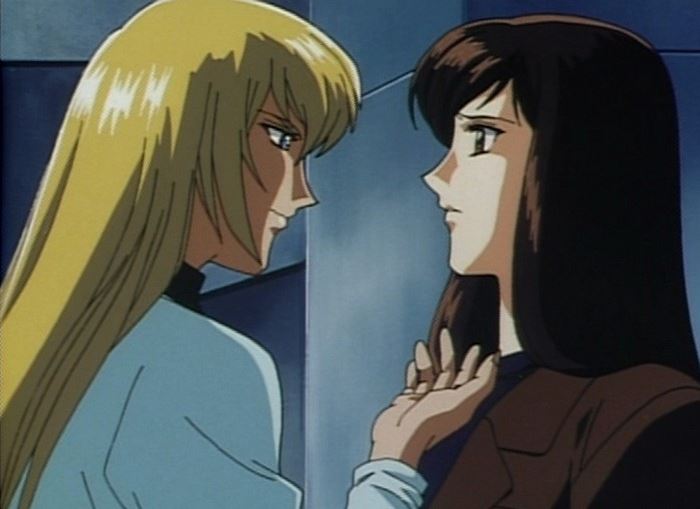
This sets her apart from Lan Asuka, who we eventually discover is a non-human of a totally different sort—an artificial being created from biblical-era instructions to inaugurate a new golden age. Asuka is also a hermaphrodite, which sets her apart from most of humanity even if her pseudo-Babylonian origins are left out of the picture. Asuka and Jun prove to be mirrors of one anothers’ personality. Both women are consumed with self-loathing and bitterness about what makes them different, but this emotion that leads Jun into humility instead leads Asuka into scorn. She views regular humanity as earth’s past rather than its future, and the devilmen and devil-beasts as evolutionary mistakes that must be wiped out in order for her to fulfill her destiny.

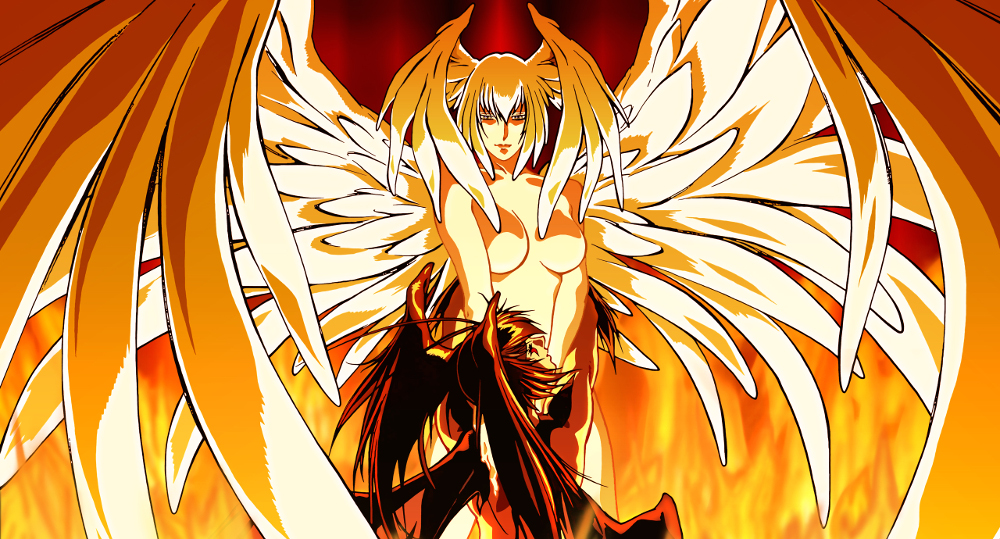
This part of The Devil Lady takes a trip into unexplained weirdness, but apparently the devilmen who have been killed in the concentration camps have been sacrificed and thrown into Hell through some weird rite that sends their life force and power to Asuka. Once she absorbs a critical mass of it, Asuka takes on an angelic form of Biblical proportions – winged, radiant, beautiful, gigantic in size, and (true to a biblical apocalypse) visible to all the earth and worshipped by it. Humanity’s elite see the proverbial writing on the wall and line up to worship Asuka as a goddess and the harbinger of a new age. However, Asuka’s paradise only applies to the “worthy”; those who don’t fit into her vision for the future (i.e. the devilmen) have no place there. This is part and parcel of the Nazi ethos that landed the devilmen in the concentration camps to start with, and Asuka is Lucifer incarnate—beautiful, all-powerful, fiendishly clever, and fatally proud. Her pride robs her of any sympathy for the weak, and even as she ushers in the start of a golden era, we see that her paradise is a sham for those who don’t meet her ideal.

The only living creature who meets Asuka’s superhuman ideal other than herself is Jun. When Asuka’s “pet tigress” refuses to join her, though, Jun gets cast into the depths of Hell itself with the other devilmen. Here Jun has an almost hallucinatory de profundis moment where she quite understandably gives up and wonders what the purpose of all her suffering was, but the memory of Kazumi renews her sense of purpose, and the rage of the slain devilmen gives her power. Jun may have nothing to lose anymore on the personal level, but she recognizes and reclaims what has been driving her all along: there are people suffering who need her help, and she alone has the power to do something about it. What happens next is possibly the coolest and most “Hell, yeah!” visual I have ever seen in anime: a pillar of fire the width of a whole city block erupts on the outskirts of Tokyo, and giga-sized Jun rises on bat wings straight out of the pit of Hell. I shit you not, the hair was standing on the back of my neck. After all she went through, seeing Jun claw her way out of Hell to kick Asuka’s ass made you want to stand up and cheer.

devil lady - dl battle 3

The final battle itself is absolutely epic and carries one final cost to Jun in the form of a double arm amputation, but the end result is worth the sacrifice. The world left in the wake of Jun’s victory is not without its problems. The rifts and emotional scars between humans and devilmen won’t heal overnight, and presumably devil-beasts may still sometimes emerge in cases where a person has a particularly striking transformation that they can’t control. But what Jun did leave behind is a world that has room for everyone, regardless of their genetics. We see this in the anime’s final scene, where two little girls run down the street together on their way home from school—one of them has a tail, and one of them doesn’t. What made me feel better than anything is seeing that this is a world that even has room for Jun Fudou. She was the person the girls brushed past on their way home, and while the sleeves of her coat flow emptily in the breeze, she herself is well-dressed and looks beautiful. Jun Fudou has become a representation for her world: scarred by her experiences, but alive, well, and forging a new future.

It’s a beautiful ending to an anime that threatened to resolve in nothing but heartbreak, and I think it’s a wonderful parting statement for this show as a work of art. I said in the first part of my coverage that The Devil Lady was so much more than its bloody cover art promised, and I hope the successive two articles showed in part why I feel this way about it. The Devil Lady goes to some incredibly dark places, but its underlying message is one of tolerance, forgiveness, and principled courage in the face of unprincipled fear. Jun Fudou is a hero for our time, or any time, and The Devil Lady absolutely deserves to be on your anime bucket list because of that.

devil lady - jun and kazumi 5

ANIME REVIEW: The Devil Lady (Part 2)

NOTE: Yikes! A whole year has passed since I posted the first part of my Devil Lady coverage. I feel sure that no one is waiting with baited breath on this as a continuation after such a long gap, but since the point of this is to spotlight a rather old anime, hopefully it will still be welcome and useful. I hope to start posting reviews here more regularly, so please bear with me!

This is the second part of Anime Obscura’s three-part coverage of the anime The Devil Lady. We will be delving into spoilers this time, so be advised.

Devil Lady - Red

In my previous review, I mentioned that The Devil Lady had many parallels with the Marvel comic X-Men in terms of telling a story about a mutant caught between a human world that hates her and a group of genocidal fellow mutants trying to recruit her. Where this anime differs from X-Men is that where Marvel’s outlook tended toward the optimistic side, The Devil Lady presents a scenario where mankind’s ugliest, darkest elements come to the fore in response to a mutant outbreak that legitimately does threaten humanity’s survival.

You have to know how the devil-beast outbreak plays out across this anime’s 26 episodes in order to fully understand this. At the outset, the emergence of a devil-beast is a very rare occurrence. A latent gene carried by some people gets triggered, usually through some psychologically traumatic event, and their bodies undergo a monstrous transformation that often overwhelms their minds and drives them insane. The extremely rare person who can keep their sanity during a devil-beast transformation and swap back and forth between their human and beast forms is called a “devilman,” and because of their combination of power, intelligence, and humanity, devilmen are highly sought-after as “hunters” by the human commando forces seeking to exterminate devil-beasts. Complicating everything, the government is doing its best to keep this war against the devil-beasts a secret to prevent widespread panic.

Fashion model Jun Fudou seemed to have a glamourous life, but as we quickly find out, once the cameras all pack up, this deeply private and reserved woman tends to retreat into herself and has few friends or family. Hers is a quiet, lonely life—but not a miserable one. This changes when beast-hunter Lan Asuka “spots” her as a carrier of the demon-beast gene and forcibly recruits her as a hunter, compelling her to transform for the first time to save her own life. The knowledge of what she is horrifies Jun, as does the prospect of fighting monsters on a regular basis, and she even contemplates suicide. She finally decides to agree to Asuka’s devil’s bargain—a normal, unimprisoned life by day in exchange for her services as a hunter by night. A final wrench is thrown into her once-peaceful existence when a younger female model and Jun’s only good friend, Kazumi Takiura, moves in with her after her parents are murdered by a devil-beast who was targeting Jun.

Devil Lady - Jun and Kazumi 1

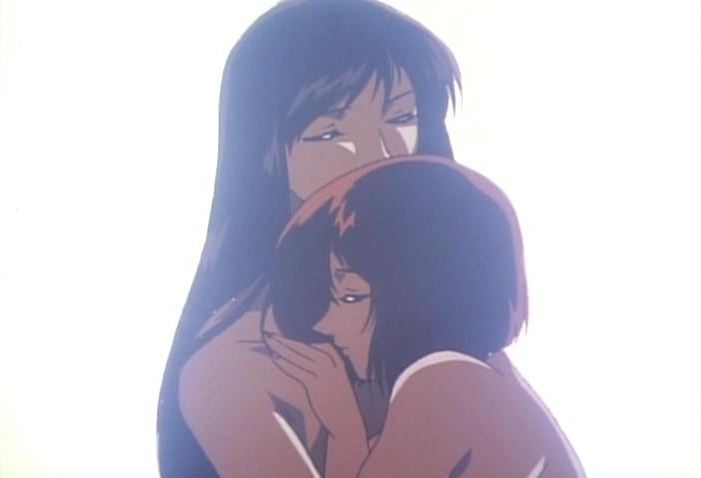
Kazumi’s arrival throws a bright spot into Jun’s life—she’s the kind of bubbly, happy influence who pairs well with Jun’s reserve, and Jun even develops feelings of love for the girl that go beyond friendship. However, the cruel beauty of this anime is that even this one bright spot only serves to highlight the dark shadows of Jun’s existence. Throughout the anime, Jun is tortured by self-loathing over her demonic “other half” that she doesn’t dare reveal to Kazumi for fear that the one person who cares for her will reject her. Lan Asuka is contemptuous of Jun’s human half and regards her as a pet tiger—more animal than human, but beautiful in her inhumanity (which doesn’t help Jun’s self-esteem, either). All of this combines to an existence that is painfully lonely and softened only by a few human ties that are incredibly fragile.

This would be interesting enough in itself, but the show takes a sharp twist when the isolated devil-beast outbreaks that Jun and Asuka have been dealing with suddenly take a numerical uptick and become a rising epidemic. The devil-beast attacks finally become too large and public to hide, and the secret gets out. There are also two other big reveals. The first is that the devil-beasts are not lone freaks. A surprisingly large percentage of humanity generally carries the gene to a greater or lesser extent—and the stimulus for an individual’s transformation can be visual and sensory. In other words, merely knowing of the existence of other devilmen or devil-beasts is enough to substantially increase the likelihood that the gene gets triggered, causing the transformation. Because of this, the government’s failure to keep devil-beasts a secret gains outsize importance, and the trickle of transformations becomes a flood. That flood becomes an apocalyptic deluge when a certain blonde gives the public “vaccinations” that actually hastens the emergence of the devil-gene, with the goal of drawing them all out into the open at once.

Devil Lady - Devil Gene 2 (Chika)The second reveal is that the devil-gene is not especially dominant in most people who carry it, and many experience transformations that are irreversible but relatively minor—they might grow a tail, or antennae, or glow in the dark—but they otherwise remain fully human. This does not stop the normal humans from rounding them up in concentration camps to commit a holocaust.
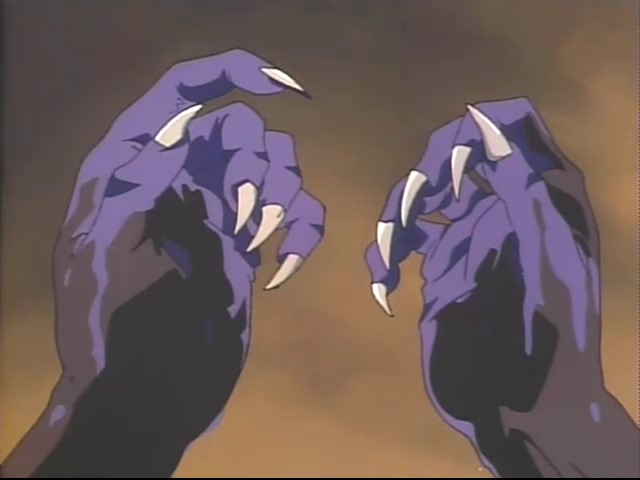
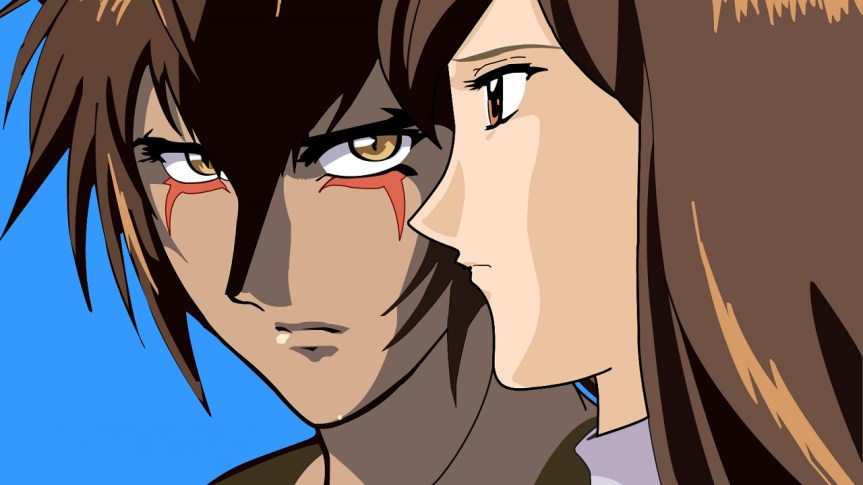
At the same time this is going on in broader society, we see this trend toward dehumanizing treatment of devilmen get applied to Jun in particular. From the very beginning, many of her many military handlers treated her as a trained animal rather than a full human being, and once her usefulness in keeping the epidemic a secret becomes a moot point, she gets caged and experimented on like an expendable lab rat. Jun is then faced with a double layer of temptation and a ton of existential moral questions. Does her self-identification as a “human” obligate her to keep fighting for other humans who treat her as less than an animal? Is she even still human? Are they now the real monsters? Should she join the other devilmen who want to establish themselves as a new “master race” on Earth? Could she be a neutral party? Would either side let her?

Devil Lady - DL Guilt 1

This theme of dehumanization was by far the darkest and most sobering element of this already-troubling anime—not because it’s over the top, but because it’s all too real. If the events of The Devil Lady took place in real life, and a new mutant strain of humanity emerged—some of whom were monsters, but some of whom were mostly like us—we would be faced with the same crisis faced in the anime. Do you embrace the sane and normal mutants, only policing those who cannot control themselves and devolve into beasts? Do you imprison them all, hoping to halt the decline of normal humanity’s numbers by isolating the gene-carriers? Or do you leave nothing to chance by wiping the devilmen from the face of the earth?

In X-Men, humanity was constantly waffling between the “embrace” and “containment” options, depending on how spooked Magneto had them on a given day. In Devil Lady, humanity immediately jumps to “containment” and moves on to “extermination” with stomach-twisting alacrity, and I can’t honestly say that I doubt the writers’ grim prediction. Openness to the unknown takes both circumspect wisdom and a lot of courage; sometimes humanity manages that on its best days. Unfortunately, humanity also disappoints a lot of the time, and mankind is especially violent and un-courageous when we’re afraid.

Devil Lady - Jun and Kazumi 3

The trend we find in Devil Lady of one group of people perpetrating atrocities on another out of fear and being led to consider them “less than human” – that isn’t fiction. It’s the same impulse that led to the Holocaust, to the Armenian Genocide after WWI, and to Joseph Stalin’s intentional starvation of the Ukraine in the 1930s. What’s so chilling and unsettling about the devilmen genocide depicted in The Devil Lady is not the possibility that it could happen, but the certainty that it could. I give this anime a lot of respect for having the courage to tread down this dark path, and even more credit for finally leading us to a way out. More on that in the next and final part of this review!

ANIME REVIEW: The Devil Lady (Part 1)

NOTE: Every once in a while, I have more to say about an anime than can easily fit in a single review. The Devil Lady, or Devilman Lady, is a thought-provoking, awesome horror / dark fantasy anime that is good enough to merit that kind of multi-part coverage. Today we’ll start with a spoiler-free review of the series to provide an overview—in the follow-up articles, I’ll dive more in-depth into the series’ symbolism, drama, and dark themes.

Lesson learned: never judge an anime by its cover art. I avoided The Devil Lady for years on the assumption that it was just another gory splatterpunk anime, a genre that tends to be strong on creative transformation sequences but pretty abysmal otherwise. However, I found that I underestimated this show. The Devil Lady has heart and a fascinatingly gray moral core.

Devil Lady - Asuka and Jun 1

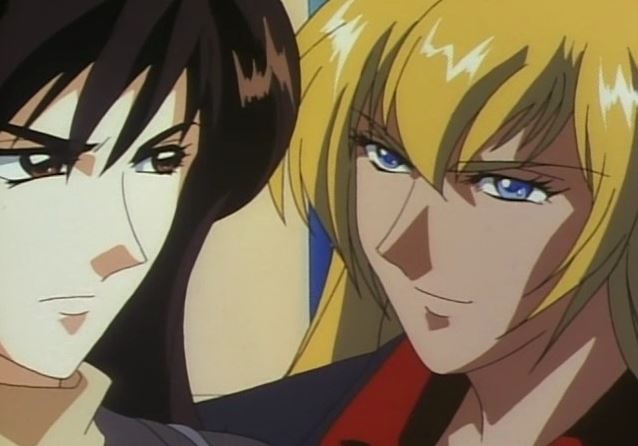
The Devil Lady is a horror story, but looking below the surface, you could also describe it as equal parts Hellsing, X-Files, and X-Men. It tells the story of Jun Fudou, a beautiful but timid fashion model who finds herself drawn into a battle for humanity’s survival. She has a strange mutation in her DNA that allows her to change into a demonic monster, but unlike most of these “devil beasts,” she retains her sanity and conscience while transformed. Jun is drafted against her will to fight other devil beasts by an ice-cold blonde named Lan Asuka who commands a secret, government-sanctioned paramilitary organization (much like Hellsing – but note that Devil Lady predates it by several years). This is a shadow war – kept out of the media, waged to end the threat of monsters who often look like ordinary people on the surface, and fought against the backdrop of a gradually unfolding conspiracy (much like X-Files). Finally, the show’s gray morality centers around Jun herself, a mutant of sorts who is fighting to save a world that hates and fears her, even as other, more violent mutants call her a traitor and mark her for death (much like X-Men). Get the idea?

It’s a weird mix that could have ended disastrously, but The Devil Lady pulls off its occult formula with flying colors. For starters, this anime is wonderful about taking its time when appropriate. It will slowly set up a creepy scene with music that makes your skin crawl. At other times, quiet, sad scenes with equally sorrowful music will absolutely break your heart. (If you haven’t noticed, I’m a fan of the score.) It also features a manageable-sized cast of characters who almost all develop as the anime progresses. You may be alternately impressed or shocked by how much you end up caring about people you assumed would only be background characters.

Devil Lady - DL Battle 2

The writing is extremely sharp, and its plot twists pass the litmus test of making even more sense after a second viewing. There are some phenomena that are never completely explained, and the extent to which all of this madness is caused by mutant biology versus the supernatural occult is an especially muddy point. However, I feel it’s acceptably ambiguous. You’re provided with all of the information you need to make sense of the story, and it’s okay to leave a certain amount open to the individual viewer’s imagination and interpretation. The rouge’s gallery of monsters is awesome – sometimes a bit weird, even considering the strange premise, but always creative and grotesque. The action sequences are well-done – not usually flashy or impressive from an animation standpoint, but their quality is consistent and does the job, and the character artwork during battle is top-notch.

Devil Lady - Rogue 2

Devil Lady does have a few possible turn-offs despite its quality, though. For one, the animation style looks very dated for a turn-of-the-millennium series, and the artwork can sometimes be noticeably dark in the literal sense. You’ll encounter quite a few scenes with dark-brown figures walking down a dark blue corridor in dim light, and the whole thing can literally be hard to see. (I think a good remaster on Blu-Ray could mitigate this through sharper clarity and contrasts.) There’s also a lot of light nudity, but it makes sense in context to heighten the animal nature of the transformed devil-beasts rather than being there for fan service and giggles. The English dub voicing is apparently a matter of some contention. I personally loved the dub, but I have read other reviews from people normally friendly to English dubs who didn’t care for it, so you may have to try it yourself to judge. Lastly, this anime shouldn’t be attempted by people who are easily depressed, because it can be a humongous downer. Once the engineers start shoveling coal in the main-character misery train, it’s full steam ahead until episode 26, and the sheer volume of unhappiness can become draining after a while.

One quick, last note: despite his heavy billing, this particular iteration of Devil Lady really isn’t manga-ka Go Nagai’s baby at all. Nagai did create the character, and his original manga introduced the characters Jun Fudou and Lan Asuka, but the similarities end there. The anime adaptation completely reworked the story and even much of the basic concept, so, love it or hate it, most of the credit for this TV series rightfully goes to Chiaki Konaka (series creator / screenplay) and Toshiki Hirano (director).

As of the writing of this review, ADV’s release of The Devil Lady is out of print, but it’s not impossibly expensive or hard to find if you get it used. I would love for another anime licensor (maybe Discotek?) to pick this one up and give it the Blu-Ray treatment. It’s honestly one of the best-thought-out and most compelling anime I’ve ever watched, to say nothing of being a great tale of dark suspense, and I have no hesitation at all in putting it in my personal “Top 5” list of favorite anime. The Devil Lady deserves better than to be cast into out-of-print hell, and if we’re lucky, someday she’ll claw her way out.

UPDATE (1/2021): Well, let it never be said that Christmas wishes don’t come true! The Devil Lady is back in print under its original Japanese title, Devilman Lady, and as I predicted and hoped for, it’s on a 1080p Blu Ray by Discotek! I was thrilled to receive my copy, and the results of their efforts are better than I could have imagined. Discotek obviously went back to the original masters for this release, because the quality of the images is leaps and bounds better than the original ADV DVDs. The HD contrast sharpened up the lines just like I’d hoped it would, but I was completely unprepared for how much better the color looked. Reds, yellows, pinks are deep, vibrant, and brilliant, and even the blues and blacks are a deeper and more consistent in a way that helps dark scenes stand out. By comparison, ADV’s transfer looks positively washed-out and almost snowy at points. Discotek also restored the original Japanese title sequence, which ADV had slightly altered to insert an English logo, in favor of keeping the original images but adding subtitles for the kanji. The Discotek release comes on two discs with an outer slipcase, and it does include ADV’s original English dub, which is one part of the original release that I gave high marks. Literally the only bad thing I have to say about this new Blu Ray edition is that they picked a fairly boring image for its front cover. Otherwise, this late 2020 release is simply outstanding. Major, major props to Discotek for giving this classic anime the gorgeous remaster it needed and deserves.

ANIME REVIEW: Yuyushiki

Yuyushiki 1

The modern “cute girls doing cute things” genre of anime based on 4-panel manga got introduced by Azumanga Daioh in 2000, was epitomized by Lucky Star in 2007, and has been copied by what feels like a half-million enjoyable but unremarkable anime ever since. It’s an innocuous little sub-genre that’s hard to get mad at or get tired of because these series tend to be adorable and fun, but it’s also hard to say anything new about the genre or break new ground in it. It’s easy for even a solid series of this type to get lost in the crowd.

So, against this endless mob of adorable competitors, how does the 2013 anime Yuyushiki hold up? Short answer: admirably well. Now for the long answer, beginning with a summary… Yuyushiki tells the story of three high school girls who are close friends, and the title comes from the fact that all of their names begin with “Yu-”: pink-haired Yuzuko, blonde Yui, and blue-haired Yukari. The series mainly just follows them around in their daily life as they have weird conversations, attend class, and hang out. The only thing resembling a plot point is that they happen to join the defunct and then-memberless “Data Processing Club” presided over by their young homeroom teacher, who they always call “Mom” because of her sweet and motherly nature. “Mom” isn’t eager to drive away her new club members by forcing them into the dry activities that likely killed the first club, so she basically lets them sit around in the computer room after school, Google things, and “process” the data they learn, often with hilarious results. And… that’s it.

Yuyushiki - Fat

It’s a simple concept… so simple that it could easily have been killed by too much gentleness or over-reliance on cuteness. Thankfully, Yuyushiki went a different route by making this a character-driven banter comedy with an old-school comedy vibe. It may sound weird to say, but Yuzuko, Yui, and Yukari have at least as much in common with the Three Stooges, Abbott and Costello, or Laurel and Hardy as they do with the heroines of 4-koma series like Lucky Star.

You have Yuzuko, the zany clown who is constantly coming up with weird ideas that throw the others for a loop (Curly, Costello, Laurel).

You have Yui, the serious-minded “straight man” who mostly serves as the voice of reason and a foil to the clown, but who is still zany enough to participate in her antics (Moe, Abbott, Hardy).

Finally, you have Yukari, your ditzy and loveable third wheel who is just as crazy as the clown but tends to bounce off her antics rather than instigate the madness (Larry, Shemp).

Yuyushiki - Prepare for death

It’s classic comedy in the best sense – you throw these strong, vivid, and funny personalities in a box, toss in a new topic every once in a while, and funny stuff happens. Most of the humor in Yuyushiki is conversational and dialogue-based, separating it from the physical humor of Nichijou or the surreal happenings of Azumanga Daioh. It also makes an effort to remain truly funny rather than just charming, which means those viewers who were exasperated by the long conversations about food in Lucky Star can unclench their teeth. Most of the characters other than the main trio are not particularly interesting, but that’s partly the point – with a few momentary exceptions, their purpose is to provide new fodder for the Yu-Yu-Yu comedy show rather than take up space as detailed characters in their own right.

Other than the classic banter comedy, the artwork is also a big draw for Yuyushiki and sets it apart from the crowd somewhat. It tends to be cartoonish and shoves detailed realism to the side, but the animators have a real gift for showing emotion (and increasing comedy) through facial expression. The voice actresses (Is there even a male character in this show?) all do fantastic jobs—again, with the main three deserving special praise. I have nothing at all to say about the music, either the BGM or the opening and closing tunes. They are entirely unremarkable, but fine. Yuyushiki was licensed and released in North America by Sentai Filmworks, and it’s a competent but fairly bare-bones release – they have both DVD and Blu-Ray options, but no English dub, no extras other than a “clean” opening and ending, and none of the OVAs (which were a bizarre but funny little CGI series where they all became catgirls in a weird pocket dimension).

Yuyushiki - Friends

The last thing I’d mention about this series might surprise you given the picture I’ve painted of it so far, but it has a knack for throwing in moments of whimsical sadness at you that breaks through the comedy to land right in your feels. Specifically, it’s very clear throughout the series that these are the adventures of these girls’ teenaged youth – a time in life that, fun as it is, won’t last forever. They will each grow up and have lives that will be more separate than they are now by necessity, and that point is poignantly made several times throughout the series. Thankfully, it’s always counterbalanced by the happy belief that friendship can endure as long as the people involved are determined it will, and that is backed up by several little moments such as “Mom” talking to her friend from high school who she still remains best friends with despite their separate professions. All-in-all, it’s a nice message that improves the show and carries with it more sweetness than sadness.

I get a sense that Yuyushiki didn’t attract much attention due to the glut of similar-looking “cute girls doing cute things” shows that also came out in 2013, but it’s definitely closer to a hidden gem than cutesy ephemera. Its old-school character chemistry comedy breathes a bit of new life into this worn-out genre, and while it won’t be a life-changer by any means, this anime is consistently hilarious, very sweet, and absolutely worth your time if you like comedy anime. Support more “Three Stooges: Cute Anime Girl Edition” series by checking it out!

Availability: This series is available as a DVD or Blu-Ray physical release licensed by Sentai Filmworks, or it can be legally streamed on the Anime Network.

ANIME REVIEW: MM!

MM 1

It Hurts So Good

Whatever else you can say about it, MM! pulls no punches when throwing out wacky examples of deviance to comedic effect. It manages be less entertaining than the sum of its parts, unfortunately, but this anime still has enough good points to be worth a watch. Before I explain, let’s rewind a minute for a summary.

Taro Sado is a high school student with a major problem – he’s a masochist, and not just a little bit. Any sudden spike of pain sends him a euphoric state and leaves him uncontrollably pleading for more. This creeps out his classmates, and it has earned Taro such a bad reputation that he’s desperate to shed his mega-masochism (the MM of the title). When he hears of the Second Volunteer Club whose stated goal is to “make students’ dreams come true,” he hopes they may be able to cure him, but their “cure” may be deadlier than his disease. The club is run by a petite but fierce blonde named Mio whose primary treatment method seems to be trying to cure his masochism by awakening his survival instinct—putting him in so much pain that fear of death overcomes pleasure! Along with the club’s other members—a cute girl named Yuno who has severe androphobia, a cross-dresser, an underaged mad scientist, and the world’s least responsible school nurse—Taro and Mio set out to discover whether or not “even if it kills you” is really a valid treatment philosophy.

MM 2

If that summary made you laugh or grin, you aren’t alone. MM!’s premise is funny as hell, and to some extent the series delivers on that promise. Mio is endlessly inventive with her methods to “cure” Taro (read: torment to the point of ecstasy), even if her success rate is questionable at best, and his reactions are just as funny. Despite the pervy subject matter, MM! also isn’t sexually explicit in any way – Taro’s turn-ons are represented by a dazed, happy look, nosebleeds, steam pouring off his head, giddy laughter, etc., and the series also features zero nudity. This is a comedy anime through and through – which in some ways is also its downfall.

The big problem with MM! is that while the comedy is fantastic, it flops in practically every other regard. This anime features no particularly unique characters, and they never get developed beyond their one-dimensional beginnings. Mio is a stereotypical tsundere who is only atypical in the violent intensity of her tsun (sour / angry) moments, and aside from the masochism thing, Taro is the same blasé good-guy male protagonist you can find in any comedy anime.

MM 3.5

The only character who receives any development at all is Yuno, the androphobic girl. The series spends a lot of time fleshing out her backstory in the first 5 episodes or so, explaining why she’s afraid of men and building a believable case why she would fall in love with Taro. This is easily the best and most interesting part of the series – it’s touching, makes you feel like the plot is going somewhere, and makes you like the characters. The problem is that this forward momentum disappears after episode 5 and is never seen again. From then on, we mainly just have gimmick-of-the-week episodes that do show Yuno and Taro growing a little closer at points, but never anything significant. This makes the romantic quality of the first few episodes feel like a tease, and it might have hurt my enjoyment more than if it had just been straight comedy the whole way through.

We’re also clearly supposed to feel that Mio is Yuno’s romantic rival, but I just can’t see it. She’s obviously a bit of a sadist (in the clinical rather than cruel sense) who is forming a symbiotic relationship with Taro in which torturing him becomes a grand old time for both of them. (She’s the last one to realize this, until it’s pointed out to her great surprise in Episode 10.) I actually really enjoyed watching her and Taro interact, and weirdly enough, Taro and Mio reminded me a lot of Charlie Brown and Lucy from Peanuts in their confused relationship. She is definitely the smug bitch who pulls the football away every single time right as he’s about to kick it, but he keeps coming back to her for psychiatric advice year after year, so clearly he feels like she’s doing him good in ways that may not be easy to articulate.

With that said, the romance element was poorly developed with Mio. Taro has very few of the bonding moments with Mio that we routinely see him get with Yuno, nor were there enough moments where Mio saw him as anything more than an interesting pastime. In short, for a character who’s essentially the series’ mascot, Mio got unpardonably short shrift in terms of meaningful screen time.

The series is at its comedic best when it spirals down into a laugh-out-loud train wreck of ridiculous deviance. Two of my favorite examples of this occur late in the series. One is where Mio hypnotizes Taro’s masochism into a suppressed state, only to have him suddenly erupt into several other different types of extreme perversion. (It cannot be contained!) Another is when the mad scientist girl kidnaps Taro to “play house” – a game where the whole cast gets involved – and the whole business devolves into a messed-up soap opera where everyone right down to the neighborhood mailman is having an affair with Taro, “the father.” MM! also occasionally goes into straight parody territory, spoofing Dragon Ball Z on two occasions. This is a little funny and results in some classic one-liners, but overall this style of humor is flatter and less interesting than the harmless raunch that makes up MM!’s original material.

MM 4

In terms of visuals and music, MM! is what I’d describe as “perfectly adequate” – neither impressive nor a letdown. The animation is middle-tier, though I will say the coloring is particularly nice – a lot of browns and deep purples that you don’t often see, and the effect is nice. For music, the background music is non-intrusive and bouncy without ever drawing attention to itself, and the ending tune is okay. The only musical standout is the catchy opening, “Help!”, which has great background visuals, a fun chorus line (“Chu-chu-chu-chu, to help you!”), and lyrics that are either funny but not cringe-worthy Engrish (“Je-sus Cri-sis Oh-My-Gah!”) or kind of sweet (“I’ll help you change your life philosophy”). There are two versions of “Help!”, called the “Hell” and “Heaven” sides. It swaps over about mid-series with new visuals, but the sound is similar enough that you might not even notice the difference aside from subtle changes to the subtitled lyrics.

Overall, MM! is pretty solid, but not everything it could have been. You will laugh to the point of tears at some points, and it’s always a fun watch. I just wish it could have spent its screen time a bit more wisely to do some actual character development in its later episodes to go along with its comedy. This is one I can definitely recommend as a streamed watch, but I can’t in good conscience recommend it as a physical purchase unless you find yourself much more impressed with it than I was.


MANGA REVIEW: Franken Fran Omnibus 1 (Vol. 1-2)

Fran 7

Delightful? Possibly. Depraved? Definitely!

Franken Fran (by Katsuhisa Kigitsu) tells the twisted story of Fran Madaraki, the only “daughter” of the mad Dr. Madaraki, who recently went missing. Thankfully, the good doc taught Fran almost everything he knew, so she has been carrying on in his stead by performing medical miracles for the highest bidder or whoever captures her sympathy. However, Fran’s sympathy should be regarded in the same light as a tiger’s attention, as it’s by no means always a good thing. Fran’s upbringing with the doctor has left her a little warped, and her idea of a happy ending and the ideas of her patients are often worlds apart.

The first thing to understand about Franken Fran is that it is at its core a collection of horror tales. I can see where the suggestive-looking cover or Fran’s whimsical, funny personality could mislead you, but don’t be fooled into thinking you’re purchasing light fare. This manga comes from an incredibly dark moral place where right and wrong have precious little bearing on the outcome. Yes, Fran has a tendency to always punish the guilty, but she has an equally strong record of perpetrating grotesque surgeries and atrocities on the innocent and the ethically neutral who have the misfortune to fall under her care. This book does contain a few genuinely happy endings, but even in those, there is usually some instance of stomach-churning collateral damage or a total mind-screw of a final twist.

Fran 5

Truly, the only “moral” to be found in Franken Fran is that you should never intentionally seek help from Fran… like, ever. I watch a lot of horror movies and am hard to shock, but after marathoning the 380 pages of utter depravity contained in this two-volume omnibus, I felt morally exhausted. I felt like I needed to put everything else aside and read my Bible for a while. For that reason alone, setting aside this series’ absolutely sick artwork, bizarre plot lines, or gobs of gratuitous gore, I have to warn you that this series is the definition of an acquired taste.

Fran 6With all these warnings out of the way, I can now breathe a little and say that this manga is absolutely stunning and easily my favorite manga release this year. Why? Above all else, the quality of the writing. The sheer originality of some of these stories is breathtaking, especially when it comes to Fran’s radical medical solutions, and some of the final twists take a moment to wrap your head around. It also bases its half-baked ideas on real science; among other things, this volume finally helped me “get” stem cells.
Furthermore, Fran herself is quite an interesting character. Her actions are morally repugnant at times, but there’s almost always solid logic behind them, as well as a genuine desire to do the right thing. She truly wants to help people and puts everything she has into doing that. The problem is that her “unique” upbringing has warped her notion of what an acceptable outcome should look like – you just have to take her as she is and hope she grows in understanding as the series progresses. Seven Seas’ choice to make Fran slur or stretch her words sometimes was a cute touch that helped me “hear” the character a little better, and it went right along with her uncoordinated wobble when she isn’t focused.

The excellent writing is served and complimented by powerful, visceral artwork. We have character models with a variety of ages, backgrounds, and even nationalities, and the backgrounds are straight out of a Hammer horror film. The gold point is in Fran’s grotesque experiments, which literally have to be seen to be believed, but the author does just as impressive work with the finished monsters. I was especially struck by the hulking lab techs who always seem to appear out of nowhere whenever Fran goes into serious mode when it comes to surgery – the brute force they convey gives many of the surprise procedures the desperate helplessness of a rape scene. The change that comes over Fran herself at these moments, transitioning from staggering half-loopiness to frightening intensity, was also perfect.

Fran 3

Besides the flat-out moral discomfort you get from Fran, really the only negative thing I have to say about the book at all is that the translation sometimes got muddy in the most unfortunate places. It always sounded natural (so, great localization), but the meaning was occasionally unclear, which became a real problem at certain twist endings. I had to re-read the ends to a few chapters and compare Seven Seas’ translation to some online fanslations to make sure I understood what was going on. There might have been some ambiguity in the Japanese as well, I guess, but I hope this will be less of a problem in future volumes.

So, that’s Franken Fran, warts and all. Because this manga is so nasty and so much of a head trip, I’m going to take the unusual step of not recommending it outright despite personally loving it. If you’re unsure, you’ll really just need to read a few pages or take the plunge to purchase it to see what you think. What I can and will say, however, is that this is one of the best-produced, original, and daring manga I have ever read. You can’t beat it for sheer nerve – which makes sense. Fran probably has a lot of sheer nerves lying around in her basement…

Fran 8